
Two-tier machine‑learning control for Air Classifying Mills.
A cascaded architecture that pairs anomaly classification with deep reinforcement learning to eliminate bin‑plugging downtime and hold an ACM at maximum sustainable throughput, deployed closed‑loop on the plant's existing Allen‑Bradley PLC over EtherNet/IP.
A calcium‑carbonate producer needed more throughput from an Air Classifying Mill (ACM) that was repeatedly throttled by two coupled problems: supply‑bin plugging that forced unplanned stoppages, and conservative, manual speed control of the classifier and rotor mill that left capacity on the table.
Ai‑OPs deployed the Koios platform to run two machine‑learning models in cascade. A classification model continuously estimates the probability that a bin is beginning to plug and, through that probability, commands the live‑bottom shakers and vibrator motor before flow is lost. That same signal feeds a deep‑reinforcement‑learning (DRL) agent that controls the mill's rotor and classifier drives, running the mill at maximum capacity when the system is clear, and easing it to a safe speed when a plug cannot be cleared. Both models run on the customer's on‑premises virtual appliance and write back to an Allen‑Bradley PLC in closed loop over EtherNet/IP.
Ai-OPs
·Two-Tier ML Control · ACM01
Background & objective
The objective was direct: increase the throughput of an Air Classifying Mill at a calcium‑carbonate production plant, without sacrificing product quality, by attacking the two failure modes that capped it.
An ACM grinds and classifies material in a tightly coupled loop. Feed enters a supply bin, a rotor mill grinds it, and an air classifier separates on‑spec product from oversize that recirculates. Throughput is bounded on one side by mechanical reliability and on the other by how aggressively the mill can be driven before quality drifts. Under conventional control, the plant was losing on both.
The control problem
- Frequent bin‑plugging events interrupted continuous operation, each one forcing an unplanned stoppage and manual recovery.
- Inefficient speed control of the classifier and rotor mill left throughput well below the mill's real capacity; operators ran conservatively to avoid plugging and quality excursions.
- High operational cost from the resulting energy inefficiency and production downtime.
- Deployment constraint: Koios had to install on the customer's existing on‑premises virtual appliance, fully air‑gapped.
Reliability and throughput are coupled: push the mill harder and plugging risk rises; run it timid and capacity is wasted. The two have to be solved together, in the same control loop.
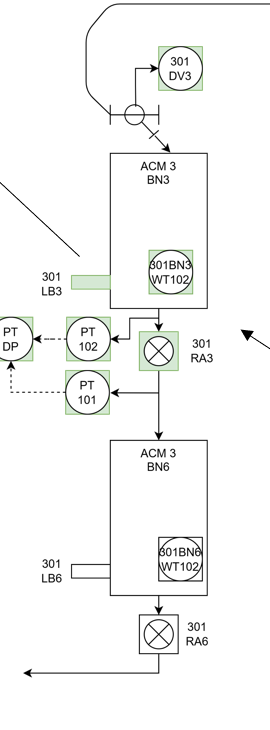
FIG. 1: ACM FLOW SHEET. Supply bin BN3 with load cell WT102 and live‑bottom shaker LB3 feeds rotary RA3; differential pressure across the classifier is measured by PT DP / 101 / 102. These are the signals the models watch and act on.
Ai-OPs
·Two-Tier ML Control · ACM02
A two-tier control architecture
Ai‑OPs cascaded two models on the Koios platform. Tier 1 classifies bin‑plugging risk and drives the mechanical clearing response. Tier 2 is a reinforcement‑learning agent that uses that risk signal to push the mill to maximum capacity, or back it off to a safe speed when a plug can't be cleared.
FIG. 2: CONTROL ARCHITECTURE. Tier 1's plug‑probability does double duty: it commands the mechanical clearing response directly, and it conditions the Tier‑2 agent that drives the mill.
Tier 1: detect & clear plugging
A classification model ingests the last several minutes of upstream signals, hopper and conveyor load cells and live‑bottom shaker motor amps, and emits the probability that a bin is starting to plug. When that probability crosses threshold, Koios writes to the PLC to start the live‑bottom shakers and vibrator motor, clearing the bin before flow is lost rather than after a stoppage.
Tier 2: maximize throughput
A deep‑reinforcement‑learning agent takes the same plug‑probability plus the live process state and continuously sets rotor and classifier speed. With the system clear it drives toward maximum sustainable throughput; as plug risk rises it trims speed, and if a plug cannot be cleared it moves the mill to a safe speed to protect equipment.
Ai-OPs
·Two-Tier ML Control · ACM2.3
Control policy: three regimes
The plug‑probability from Tier‑1 partitions operation into three regimes. The two‑tier system moves between them automatically and continuously; there is no operator hand‑off.
FIG. 3: POLICY REGIMES. Reliability and throughput are governed by one cascaded loop; the agent never has to choose between protecting the mill and pushing it.
03
Implementation & integration
Data & detection
Historical and real‑time data, feed rate, rotor and classifier speed, airflows and output quality, were drawn from existing data stores. Plugging anomalies were learned from conveyor and hopper load cells and live‑bottom shaker amps. In validation the detector flagged plugging ~20 minutes ahead of the actual event, giving the mechanical response time to clear the bin first.
Closed-loop deployment
Models first ran in monitoring mode for validation, then were promoted to closed‑loop control, dynamically adjusting ACM parameters through the existing Allen‑Bradley PLC over EtherNet/IP, with Koios hosted on the customer's VM. Total design and delivery time was under 45 days.
Operators switch Koios in or out per loop from embedded faceplate buttons, full transparency between existing and AI control, no black box.
Ai-OPs
·Two-Tier ML Control · ACM04
Results
Within the pilot, the two‑tier system both stabilized the mill and lifted its ceiling, recovering capacity that conservative control had been leaving idle.
FIG. 4: SPEED STABILIZATION. Recreated from the plant HMI trend captured on‑site. Under old control the rotor speed swung widely with recurring spikes; once Koios took the loop, speed settled into a tight, predictable band, the signature of a mill held near capacity without plugging.
Product quality was unaffected: the system maintained tight tolerances in particle‑size distribution, meeting the stringent specifications required for industrial calcium‑carbonate applications. A planned next step folds QA measurements directly into the model so quality becomes an explicit optimization target alongside throughput.
Ai-OPs
·Two-Tier ML Control · ACM05
Where this applies
The same pattern, anomaly detection feeding a reinforcement‑learning controller, closed‑loop on existing PLCs, generalizes across mining and minerals processing. Applications available today on Koios:
About Koios
Koios is Ai‑OPs' self‑hosted machine‑learning inferencing platform for deploying scalable AI models on industrial control systems. It is hardware‑agnostic, runs fully on‑premises and air‑gapped, and writes optimized control back to PLCs, SCADA and smart instruments in real time. Your models and data stay inside your plant; you own every model Koios trains.
It installs as a single Docker image from a Docker Verified Publisher, or as an offline ISO / virtual‑appliance image, and is licensed as an annual per‑instance subscription.
| Protocols | EtherNet/IP · OPC‑UA · Modbus TCP · BACnet & more |
| Deployment | On‑prem · air‑gapped |
| Install | Single Docker image / ISO |
| Min. hardware | 4‑core 64‑bit · 8 GB RAM · 128 GB SSD · 1 GbE |
| Per license | Unlimited devices, tags & models · historian & diagnostics · support |