
Soft analyzers and soft instruments: measuring what the plant can't sample.
A soft analyzer infers a hard‑to‑measure property, molecular weight, acid number, density, composition, in real time from signals the control system already has. No new analyzer, no waiting on the lab. It updates every cycle, flags hard instruments that are drifting, and gives engineers a trustworthy continuous value to tighten specifications and control tolerances. It runs on Koios, closed in software on the existing control system.
Some of the properties that matter most to a process, product molecular weight, acid number, sulfur, density, composition, are slow, expensive, or impossible to measure online. They arrive as infrequent lab samples that lag the process by hours, so operators run with wide margins and control systems run blind between readings.
A soft analyzer (also called a soft sensor or virtual analyzer) closes that gap. It is a data‑driven model that infers the property continuously from common measurements the control system already records, and serves it back as a live soft instrument on the operator graphics. Beyond control, the same value reduces manual lab sampling, supplies a trusted input for tighter specification and control tolerances, and detects drift and instrument health by comparison against the real signal. This paper shows the concept and two validated examples, a molecular‑weight analyzer and an acid‑number analyzer.
Ai-OPs
·Soft Instruments & Analyzers01
Not just control: other great uses
The same models that run a loop can also measure. Point one at a hard‑to‑sample property and it becomes a soft instrument: a continuous, online estimate where today there is only an occasional lab number.
A soft analyzer learns the relationship between a target property and the routine signals that move with it, then predicts that property every cycle. Once it exists, it earns its keep in several ways at once, well beyond closed‑loop control.
What it delivers
- Fewer manual samples: a continuous estimate replaces much of the routine grab‑sample and lab workload.
- Tighter specs & tolerances: a trustworthy live value lets the plant operate closer to limits with confidence instead of wide safety margins.
- Drift & health detection: compared against the real instrument, the soft value flags drift, plugging and valve or flow problems early.
- New control inputs: it hands advanced control a real‑time quality signal that simply was not available before.
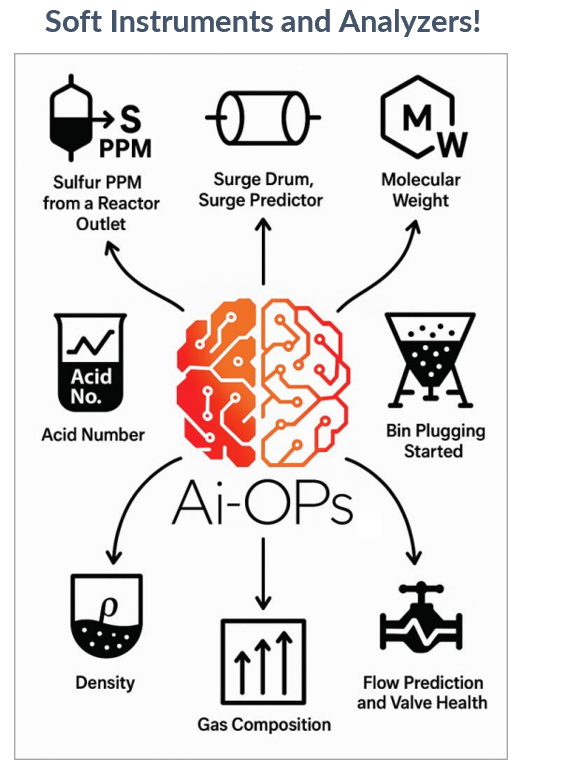
FIG. 1: NOT JUST CONTROL. A single platform infers a wide range of properties and events from existing process data, sulfur, molecular weight, acid number, density, gas composition, surge prediction, bin plugging, and flow / valve health, each one a soft instrument the plant did not have before.
Every soft instrument is a new measurement created in software from data you already collect. No tap, no sample loop, no capital analyzer, just a model running on the values already on the network.
Ai-OPs
·Soft Instruments & Analyzers02
How a soft analyzer works
A model is trained on history to map common process signals to the target property, then runs on Koios every cycle and publishes the result to the operator graphics as a labelled soft instrument, sitting right beside the hard instruments it complements.
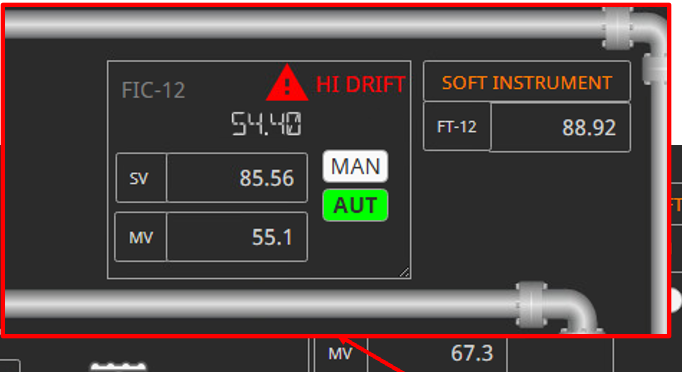
FIG. 2: ON THE OPERATOR GRAPHIC. The soft instrument reads alongside the live loop. Because it is an independent estimate of the same quantity, a growing gap against the hard instrument raises an early HI DRIFT flag, turning the soft value into a continuous instrument‑health check.
Trained, then inferenced
The model is trained offline on historical operation, then exported and run on Koios. Each cycle it reads a short window of recent history and outputs the current property value, so it responds to trends rather than a single noisy sample.
Built from data you already have
Inputs are common DCS measurements already on the network: routine flows, temperatures, ratios and equipment age. There is no new field instrumentation, no analyzer house, and no sample system to maintain.
Two ways it is used
As an advisory soft instrument for operators and the lab, and as a real‑time input to advanced and closed‑loop control, with the existing controls always available underneath.
Ai-OPs
·Soft Instruments & Analyzers03
Validated example: molecular weight
A soft analyzer that infers product molecular weight in real time, a property that otherwise depends on slow, periodic lab analysis, from routine process measurements alone.
The analyzer estimates molecular weight every cycle from common process signals, reactor flows and ratios, temperatures and catalyst age. It carries no new instrumentation; it reads what the control system already records.
| Inferred property | Product molecular weight (g/mol) |
| Inputs | Routine process signals |
| Update rate | Every 1 hr (3600 s scan) |
| History window | 24 samples |
| Output | Positional, online estimate |
Validation results
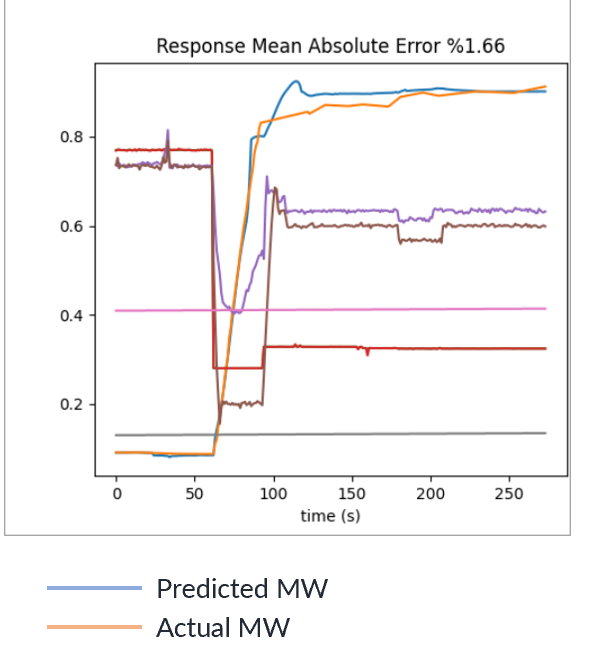
FIG. 3: PREDICTED VS ACTUAL. The soft analyzer (predicted) tracks the measured molecular weight through a large transition and settles onto it, at a response mean absolute error of 1.66%. The remaining traces are normalized model inputs.
Robust accuracy under standard production conditions, with specific operating regions flagged for further improvement. Good enough to cut manual sampling and to tighten how close to spec the unit can run.
Ai-OPs
·Soft Instruments & Analyzers04
Validated example: acid number
A soft analyzer that infers acid number continuously from routine process data, and, as a bonus, reads as an early indicator of catalyst condition.
Like the molecular‑weight analyzer, this model estimates acid number every cycle from common process measurements, reactor feed flows, ratios, temperatures and catalyst age, with no new instrumentation.
| Inferred property | Acid number (mg KOH/g) |
| Inputs | Routine process signals |
| Update rate | Every 1 hr (3600 s scan) |
| History window | 12 samples |
| Output | Positional, online estimate |
Validation results
Accuracy degrades predictably as the catalyst ages, with higher error expected near end of life. That sensitivity makes the same model a useful catalyst‑health indicator.
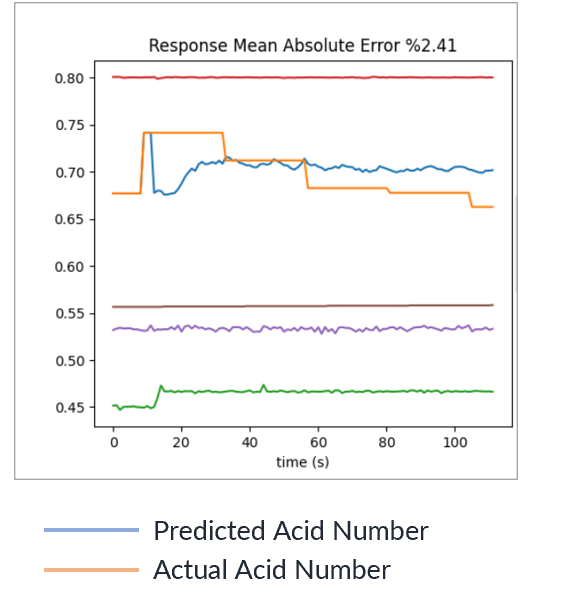
FIG. 4: PREDICTED VS ACTUAL. Predicted acid number follows the measured value across normal operation at a response mean absolute error of 2.41%. The remaining traces are normalized model inputs.
Between infrequent lab titrations, the analyzer gives operations a continuous read on product acidity, enough to reduce sampling and to hold the property inside a tighter band.
Ai-OPs
·Soft Instruments & Analyzers05
Where this applies
Any property that is slow, costly or impossible to measure online, but moves with signals you already record, is a candidate for a soft instrument. Examples deployed and available on Koios:
About Koios
Koios is Ai‑OPs' self‑hosted machine‑learning inferencing platform for deploying scalable AI models on industrial control systems. It is hardware‑agnostic, runs fully on‑premises and air‑gapped, and reads and writes DCS, PLCs and SCADA in real time. Your models and data stay inside your plant; you own every model trained for you.
It installs as a single Docker image from a Docker Verified Publisher, or as an offline ISO / virtual‑appliance image, and is licensed as an annual per‑instance subscription.
| Protocols | OPC‑UA · EtherNet/IP · Modbus TCP · BACnet & more |
| Deployment | On‑prem · air‑gapped |
| Install | Single Docker image / ISO |
| Min. hardware | 4‑core 64‑bit · 8 GB RAM · 128 GB SSD |
| Per license | Unlimited devices, tags & models |
Note: specific tag names, input lists and certain product details for the examples shown are withheld under a customer non‑disclosure agreement. Process signals are described here in general terms only.